terça-feira, 21 de abril de 2015

Country Joe McDonald - Goodbye Blues 1977

Political and ecological issues were set to musical accompaniment by Country Joe McDonald, who co-founded and led the psychedelic folk-rock band Country Joe & the Fish, the leading left-wing band of the '60s. Since the group's breakup in 1971, McDonald has continued to musically espouse his political views through his original, folk-like songs.
A native of Washington, D.C., McDonald grew up in El Monte, CA, a suburb of Los Angeles, where his parents, Florence and Worden, had moved to escape political difficulties in the capital city. Music played an important role through McDonald's childhood, and he attended many concerts at El Monte Legion Stadium; after becoming enchanted by Dixieland music, he frequented the Lighthouse Club in Hermosa Beach.
At the age of 17, McDonald enlisted in the U.S. Navy. Following his discharge after three years, he attended City College in Los Angeles for a year. Although he moved to Berkeley to continue his schooling, McDonald was distracted by his love of music and spent most of his time playing in bands like the Berkeley String Quartet and the Instant Action Jug Band, which included future bandmate Barry Melton.
Joined by folk guitarist Blair HardmanMcDonald recorded his first tunes in 1964. Released originally by First American Records, many of the songs were later re-recorded by McDonald for his 1976 albumThe Goodbye Blues.
McDonald continued to be active in politics in the mid-'60s, and published a left-wing magazine, Rag Baby. After publishing the first few issues of the magazine, McDonald conceived the idea of recording a special "talking" issue. Released as an EP, the issue featured two songs, "I Feel Like I'm Fixing to Die Rag," a Dixieland-like indictment of the Vietnam War, and "Superbird," a satire aimed at President Lyndon Johnson; both were credited to "Country Joe & the Fish." Following the completion of the project, McDonald and Melton agreed to form a more serious rock band.
With McDonald's political lyrics set to a dynamic rock beat, Country Joe & the Fish became popular in the San Francisco Bay area, performing frequently at the Jabberwocky coffeehouse in Berkeley and the Avalon and Fillmore Auditorium in San Francisco. Their second EP featured three of McDonald's tunes -- "Bass Strings," "Section 43," and "(Thing Called) Love."
Signed by Vanguard Records in December 1966, Country Joe & the Fish soon released their first album, Electric Music for the Mind and Body. Although "I Feel Like I'm Fixing to Die Rag" was intended to be included on the album, the record label convinced McDonald to omit it. It was finally released as the title track of the band's second album. A single of the tune reached number 32 on the Billboard charts. McDonald & the Fish made their East Coast debut at the Cafe Au Go Go in 1967. Following the release of their third album, Together, in 1968, the band toured Europe, where they were met by enthusiastic crowds. Their fourth album, Here We Are Again, released in 1969, featured musical guests Jack Casady of Jefferson Airplane and David Getz and Peter Albin of Big Brother & the Holding Company.
Together with the FishMcDonald performed at most of the major music festivals of the '60s. Their performance at the Monterey Pop Festival in 1967 was featured in the film of the event. In addition to performing with the group at Woodstock in August 1969, McDonald performed a solo set that was capped by his obscene altering of the "Fish Cheer" intro to "I Feel Like I'm Fixin' to Die." Featured in the movie of the festival, the intro brought McDonald to international attention.
Woodstock, however, came during the final stages of the band's tenure. In the aftermath of the festival, McDonald was arrested in Worcester, MA for inciting an audience to lewd behavior, while Melton was arrested for possession of marijuana. Although they recorded a final album, C.J. Fish, with a new keyboard player and rhythm section, and had appeared in the 1970 film Zacharia, Country Joe & the Fishdisbanded in 1971.
By that time, however, McDonaldhad signed a solo contract with Vanguard and recorded two albums in Nashville -- Thinking of Woody Guthrie, released in December 1969, and Tonight I'm Singing Just for You, released in May 1970. McDonald continued to tour and record as a solo singer/songwriter. During a tour of England, he recorded an album, Hold On: It's Coming, with accompaniment by Fleetwood Mac guitarist Peter Greenand other British musicians. In Scandinavia, McDonald was contracted by film producer Knud Thorbjorsen to compose songs for a film based on Henry Miller'snovel Quiet Days in Clichy. The three songs he wrote -- "Mara," "Ny's Song," and "Henry Miller and the Hungry World" -- were included on the film's soundtrack. When Grove Films attempted to import copies of the film to show in United States theaters, they were seized by customs and dubbed "obscene." Grove Films eventually won a court battle, and the movie premiered in New York in 1971. McDonaldlater scored and appeared in a Chilean film, Que Hacer, documenting Salvador Allende's successful campaign for president.
Beginning in April 1971, McDonald became active in the growing anti-war movement and appeared at demonstrations in San Francisco and Washington, D.C.. Together with Jane Fonda and Donald SutherlandMcDonald appeared during an FTA (Free the Army) tour of Vietnam that featured skits by former Second City members Ann and Roger Bowen. Although he became disenchanted with Fonda'spolitical views and left the show, the experience earned McDonald a spot on President Nixon's enemy list.
Returning to the United States, McDonald recorded an EP with the San Fransisco-based band Grootna. A solo performance at the Bottom Line was released as a live album, Incredible Live!, in 1972. During 1972 and 1973,McDonald performed with the All-Star Band, a group mainly comprised of members of the Fish and Big Brother & the Holding Company. The band accompanied McDonald on his 1973 album Paris Sessions.
McDonald spent most of 1974 living in Europe. Returning to California in 1975, he joined a band, Energy Crisis, that featured former Fish Bruce Barthol and ex-Instant Action Jug Band member Phil Marsh. The band appeared onMcDonald's 1975 album, Paradise With an Ocean View. The album, which included the anthemic tune "Save the Whales," reflected an increase in McDonald's ecological commitment.
The remainder of the '70s represented McDonald's most prolific period as he released seven albums -- Love Is a FireGoodbye Blues,Rock & Roll Music from the Planet EarthLeisure SuiteOn My OwnInto the Fire, and Child's Play. In 1977, Country Joe & the Fish temporarily came together again to record an album, Reunion.
Beginning in 1982,McDonald became involved with furthering the cause of Vietnam veterans and worked with such groups as Vietnam Veterans Against the War, Swords to Plowshares, and Vietnam Veterans of America. His experience peaked with the release of an album and video, Vietnam Experience, in 1988.
McDonald's 1991 album,Superstitious Blues, was a mostly acoustic effort and included two songs recorded with Jerry Garcia of the Grateful DeadCarry On, released in 1995, was inspired by the death of McDonald's parents and featured his touching tribute to Florence Nightingale, "The Lady with the Lamp," and the title track, which featured Garcia on electric guitar. AMG.

listen here

Buy @ Amazon: USA - FR - UK

sábado, 11 de abril de 2015

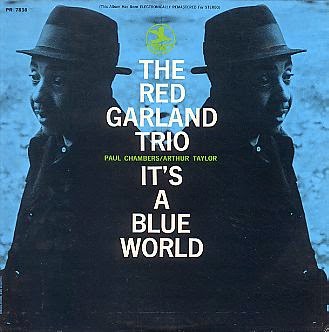
Red Garland Trio (with Paul Chambers & Art Taylor) - It's a Blue World 1958

Of the miles of Red Garland sessions recorded in the late '50s, some of the tapes didn't see the light of day until many years later. This session, except for "Crazy Rhythm," first appeared in the early '70s, and is typical of Garland's trio work of the '50s, evoking a mid-century nightclub atmosphere from Rudy Van Gelder's studio with the perfectly gauged help of bassist Paul Chambers and drummer Art Taylor. "Since I Fell for You" and "Teach Me Tonight" are taken at relaxed tempos, and after Garland's trademark block chords in the left hand and octaves in the right hand take care of the themes, they ride easily and winningly. "Crazy Rhythm" zips along at the usual steeplechase pace, with a fluid bebop solo from Garland and some agile bowing from Chambers (Chambers also gets an unusually lengthy bowed solo on "This Can't Be Love"), and the title track closes the CD reissue on a jaunty note.Garland fans -- and for that matter, fans of Vince Guaraldi, whose chord voicings very much resemble those of Garland -- need not hesitate. AMG.

listen here

Buy @ Amazon: USA - FR - UK

RE-POST: Stardust International & Tayfun - Stardust International & Tayfun 1973

Rare private pressed LP from swedish funk group. Give it a try. 

listen here

Buy @ Amazon: USA

Pussy - Invasion 1972

Collection of tracks from this early 70s post-Jerusalem UK hard rock group also managed and produced by Ian Gillan (Deep Purple). The band was formed immediately after the break-up of Jerusalem by it’s founding members Paul Dean & Ray Sparrow along with Bob Cooke, who was eventually replaced by Brian Goff. The recordings featured here include previously unreleased tracks planned for Pussy’s debut album, plus cuts from their lone 45rpm single release on the Deram label, as well as other previously unreleased recordings by both of the group’s line-ups.

listen here

Buy @ Amazon: USA - FR - UK

War - Why Can't We Be Friends 1975

Cut from the same cloth as the band's 1973 Deliver the Word LP, War's 1975 Why Can't We Be Friends? is a masterpiece in its scope and breadth. And, emerging as the last work the band would do for its longtime label, United Artists, it became a fitting swansong, powering up the charts and givingWar its fourth and final number one hit. In recent years, the album has been overshadowed by the monstrously popular bass-beating and bright brass of its singular hit, "Low Rider." Indeed, the song would become the band's signature theme, as the Latino street-cruiser jam quickly became a live set staple and, much later, was reinvigorated through sampling on songs by the Beastie BoysStereo MC's, and Offspring. However, that one track, iconographic as it is, is by no means the only treat onboard Why Can't We Be Friends? There are far more interesting and superb treats roiling in the wake of "Low Rider." The snappy title track, which poses the question of the decade and, oddly, closes the album, is a feel-good thumper. Its bright brass punctuation and rakish vocals are wonderfully combined with an absolutely contagious reggae beat. Then, add the doesn't-get-much-better-than-that medley "Leroy's Latin Lament." Divided into four "songs," the music swings from the smart vocal opening "Lonnie Dreams" to the effervescent Latin jam of "La Fiesta." And, of course, where there's War, there's funk -- this time on the seven-plus minute"Heartbeat." Wrap it all up with the poignant ballad "Lotus Blossom," and the result is pretty much perfection. Why Can't We Be Friends? remains one of War's truly outstanding efforts, and has become an integral part of the funk genre's landscape. It also remains the nightcap of their finest hour. War's ill-timed move to MCA changed the energy and focus of the band forever. AMG,

listen here

Buy @ Amazon: USA - FR - UK

White Light - Velvet Sandpaper 1973

"Velvet Sandpaper" from ex-White Light vocalist with unusual worldweary "older guys" sound and titles such as "Mistrust-Separation-Divorce". Hard to describe accurately, but traces of late-period Doors and Tim Buckley can be found on things like the excellent "Blue Love". Comparable to the experience of sharing a drink with a stranger down on his luck at a desolate nightclub, then seeing him actually get up on stage and sing a few songs about his misfortunes as the closing hour approaches.

Also a harder fuzz edge with creeping menace on a couple of tracks such as the terrific "Light", and some hints of the barrock groove aspirations of White Light, but these are exceptions to the overall scotch-laden introspection Mr Mississippi projects. Pro-sounding band and vocals that hit just the right spot. This strikes me as a lot better than the White Light LP, and it's strange that it hasn't become more well-known.

Originally from New York, Gary "Mississippi" Abrams recorded this album in California 1973 with two completely separate sets of musicians. In 1980 he released another LP titled "Breaking Out". He worked with the Perron Brothers (White Light) for several years under various band names.

listen here

Buy @ Amazon: USA - FR - UK

Arthur, Hurley & Gottlieb - Arthur, Hurley & Gottlieb 1973

Namesakes Jeffrey Arthur, Neil Gottlieb, and Michael Hurley discovered a common interest in music while they were attending the University of South Florida in the early 1970s.  The trio somehow attracted the attention of Clive Davis who signed them to Columbia.  Co-produced by Clay Pitts and David Spinozza and recorded in New York with an all star cast of sessions players, the group made their debut with 1973's cleverly-titled "Arthur Hurley & Gottlieb".  Arthur was responsible for all of the material which was heavily geared to sensitive singer-songwriter and country-flavored moves.  So here's the thing - these guys weren't half bad.  As lead singer Arthur had a decent voice and exhibited a knack for crafting a pretty melody.  Unfortunately, the album lacked a single original note or thought.  This was literally music as a product, rather than art.

listen here

Buy @ Amazon: USA - FR - UK

Big Brother Ernie Joseph - South East Tour 1971

Supposedly "South East Tour" was originally released in 1971 under All American catalog number AA-5773-LPD.  Not that we're experts or anything, but we've never seen an original copy of the album which probably makes Akarma's 1998 reissue your only real choice if you want to hear this set.

The title and packaging certainly give you the impression this is a live set, but that's not really the story here. Half of the ten tracks are pulled from Joseph's earlier band - A Giant Crab Comes Forth.  (I'm too lazy to pull the LP, but I think the songs are all pulled the first Giant Crab LP).  The other five selections are billed as previously unreleased efforts, but tracks such as "Keeping the Faith" and "How Many Times" don't sound like concert recordings to our ears.  In terms of quality, the new stuff varies from ponderous boogie ("Satisfied Woman") to mildly entertaining ("Truthfulness").  To be honest,  Giant Crab tracks such as the fuzz guitar propelled "Hotline Conversation" and the blue-eyed soul-ish "Save Me (Save Me)" provide the highlights.

listen here

Buy @ Amazon: USA - FR - UK

Twin Engine - Twin Engine 1971

These 12 songs were recorded by Twin Engine in 1971 with the intention of getting an album together for release on United Artists, but they weren't issued until more than 30 years later. The music has very much of a 1970 aura, mightily influenced at different points by the Let It Be-era Beatles (particularly in the guitar sound of "Give My Love a Chance," "The Time Is Now," and "Mistress of the Morning"),Crosby, Stills, Nash & Young (a riff in "The Time Is Now" seems airlifted directly from Neil Young's "Cowgirl in the Sand"), American Beauty-era Grateful Dead, and the country-rock being laid down bythe Flying Burrito Brothers/Byrds axis in Southern California in the late 1960s and early 1970s. (That last influence may not have been entirely due to chance, as Byrds and/or Burritos members Chris HillmanClarence White, and Sneaky Pete Kleinow are all referred to in the packaging as having played on the sessions, though it's not specified who played on what track). It's very accomplished, and Twin Engine's duo harmonies are quite cheerful and invigorating. What it lacks is a sound of its own, and it's easy to see that a label of the time might have passed on it due to its similarity to some other bands of the era, or at least encouraged the pair to keep working up material until something more distinctive evolved. Now that competing in the marketplace isn't a concern, it's actually a pretty pleasant listen -- derivative, yes, but considerably stronger and more polished than most albums that are heavily derivative of their surrounding times and styles. There are the makings of a solid country-rock band here, albeit one more pop-influenced than most, like a less-slick Eagles. While it's too bad they didn't get any further, this relic of their abortive flight isn't at all bad. AMG.

listen here

Buy @ Amazon: USA - FR - UK

William Truckaway - Breakaway 1971

After leaving the Sopwith Camel singer/songwriter William Truckaway recorded one of the great lost singles of the early '70s, "Bluegreens." It is an insanely catchy ditty built around a chunky synthesizer and simple hippy-dippy sentiments with a multi-tracked Truckaway and the Stovall Sisters providing some truly blissed-out vocals. It was enough of a hit that Taco Bell used it for an ad campaign and it got Truckaway an album deal with Reprise. Breakaway, which contains "Bluegreens," was released in 1971 and it is a wonderfully sweet and mellow album from a guy who sings like he could charm the leaves off the trees in the summertime. The album has a relaxed and easygoing sound with plenty of gentle strumming and tender vocalizing but also inventive arrangements (synths, sitars, congas, flutes, strings, backing vocals) that give his thoughts about getting out of the city ("Hard," "Cold City Life"), going slow ("I Go Slow"), finding Jesus ("Leave It There") and love lost ("Where's My Baby") and found ("Way to My Heart," "Be the One") -- an extra punch that many of his contemporaries lacked. You could compare Truckaway without much of a stretch to John Sebastian, since the Sopwith Cameland the Lovin' Spoonful shared a sound and a producer (Erik Jacobsen, who also fulfills those duties with Truckaway here). Breakaway isn't a lost classic by any means but it is a satisfying and interesting listen that deserves to be reissued outside of Japan. AMG.

listen here

Buy @ Amazon: USA - FR - UK

Procol Harum - Shine On Brightly 1968

For a group that lived their life in the shadow of their debut single, Procol Harum released some music of remarkable quality. Originally released in November 1968, Shine On Brightly is regarded by many as the group's best album. It is certainly their most influential.
Although produced by Denny Cordell, it is clear that the young assistant producer, Tony Visconti and engineer Glyn Johns have their fingerprints all over it. Quite Rightly So and the title track (''And even my befuddled brain is shining brightly quite insane'') are masterpieces of organ-driven, symphonic rock.
Skip Softly (My Moonbeams) is very much a product of its era, but much better is Wish Me Well, one of the group's most explicit nods to their R & B roots. Rambling On sounds like a virtual blueprint for David Bowie's Hunky Dory.
The album is dominated by the side-long In Held Twas I. It encapsulates the period's hope and opulence. With Keith Reid's frequently impenetrable but deeply poetic words, it is something grand sounding even grander. Parts of it is extremely listenable (In The Autumn Of My Madness), some of it exceptionally dated (Twas Teatime At The Circus, anybody?). It is impossible, however, to deny its influence on the Who's Tommy and Queen's Bohemian Rhapsody.
Gary Brooker's vocals are tremendous throughout, again making a case for him being one of the most underrated vocalists in the UK pop history. With Robin Trower's unobtrusive guitar and Matthew Fisher's organ, the Procol Harum sound is one of the most definable of the late 60s.
Given its largesse, it was a surprise that Shine On Brightly failed to make the UK charts. However, it reached the US Top 30 and cemented their popularity in the states. Now, it is part of their meticulously researched 40th Anniversary series and comes complete with 12 bonus tracks.
If you are unfamiliar with their oeuvre and had enough of A Whiter Shade Of Pale, listen to this and understand why Procol Harum was so feted.

listen here

Buy @ Amazon: USA - FR - UK

Ângela Ro Ro - Angela Ro Ro 1979

Ângela Ro Ro studied classical piano from an early age. Her nickname Ro Ro is derived from her rough and low voice. She began to play around the Carioca neighborhood of Ipanema, and soon, influenced by her idol Ella Fitzgerald(along with Maysa and Jacques Brel), she moved to London during the military regimen, where she survived upon small jobs while performing around the city. Returning to Brazil in 1979, she was hired by Polygram, recording her first album in that year, Ângela Ro Ro, which had the hits "Amor, Meu Grande Amor," "A Mim e a Mais Ninguém," and "Tola Foi Você." Always faithful to her dramatic, irreverent, sexually unconventional, and explosive character, Ro Ro followed her career, recording in 1980 the LP Só Nos Resta Viver, which had a great success with the title track; "Tango da Bronquite" also was a hit. "Escândalo," by Caetano Veloso, is from the 1981 LP of the same name, and made reference to the headlines accounting the explosive rupture of her affair with singer Zizi Possi. In 1982, she had another hit with "Simples Carinho" (João Donato/Abel Silva), included in the 1983 same-titled LP. Maria Bethânia, who had recorded "Gota de Sangue" in her Mel LP (1979), re-recorded "Fogueira" (1983), which was recorded by Ângela Ro Ro in the same year for the Simples Carinho LP. A Vida é Mesmo Assim (1984) had success with the title track. Besides her participation in the Songbookseries (Lumiar), she recorded the following solo LPs/CDs: Eu Desatino (1985), Prova de Amor(1988), Nosso Amor ao Armagedon (Ao Vivo) (1993), and Acertei no Milênio (2000). In 1996, Barão Vermelho had a hit with the re-recording of "Amor, Meu Grande Amor." In the same year, Polygram reissued in CD the 1982 LP Simples Carinho. In 1997, Eldorado reissued in CD the 1988 LP Prova de Amor. AMG.

listen here

Buy @ Amazon: USA - FR - UK

Ramsey Lewis - Funky Serenity 1972

Cleveland EatonEd Greene, and Morris Jennings accompany Ramsey Lewis on this commercial-flavored 1973 release. While jazz/pop/soul versions of "Where Is the Love" and "If Loving You Is Wrong" come off limp, spacy renditions of "Nights in White Satin"; EatonJennings, and Lewis' two compositions, "Serene Funk" and "Dreams"; and a beautiful interpretation of Thom Bell and Linda Creed's "Betcha by Golly Wow" make this an enjoyable and essential reissue. Originally issued on Columbia Records (1973). AMG.

listen here

Buy @ Amazon: USA - FR - UK